Table of Contents
ToggleCrosley Furniture has carved out a solid reputation in the ready-to-assemble furniture market, especially for homeowners looking to add functional workspace and storage without the price tag of custom cabinetry. Their kitchen islands blend traditional styling with modern practicality, offering everything from butcher block tops to stainless steel work surfaces. If you’re considering a Crosley island for your kitchen, you’ll want to understand what sets these units apart, how to choose the right model for your space, and what to expect during assembly. This guide walks through everything from sizing and features to installation tips and styling ideas.
Key Takeaways
- Crosley furniture kitchen islands are constructed from solid hardwood and wood veneers rather than particleboard, offering superior durability and longevity compared to budget flat-pack alternatives.
- Crosley islands come with multiple countertop material options—including butcher block, granite, stainless steel, and natural wood—each requiring different levels of maintenance and suited for different cooking styles.
- Proper sizing is essential: measure your space with painter’s tape, allow at least 42 inches of clearance on all sides, and confirm at least 10–12 inches of overhang if you plan to add bar seating.
- Assembly typically takes 2–4 hours with basic tools and a second pair of hands; acclimate the wood for 24–48 hours beforehand to prevent warping and joint separation in your home’s climate.
- Styling upgrades like swapping hardware, refinishing the base, or adding battery-powered lighting can transform your Crosley island from traditional to match your kitchen’s aesthetic without major modifications.
- Popular storage features such as soft-close drawers, pull-out trash bins, and adjustable shelving maximize functionality, though not all models include soft-close hardware—check before purchasing if it’s a priority.
Why Choose a Crosley Furniture Kitchen Island?
Crosley kitchen islands occupy the middle ground between big-box flat-pack furniture and custom-built cabinetry. They’re constructed from solid hardwood and wood veneers, not particleboard, which gives them better longevity and a more substantial feel. The joinery typically uses a combination of dowels, glue, and cam locks, standard for RTA furniture but executed with tighter tolerances than budget alternatives.
The brand offers a range of countertop materials: butcher block (usually rubberwood or acacia), granite, stainless steel, and natural wood finishes. Butcher block tops need periodic oiling with food-grade mineral oil to prevent drying and cracking, but they’re repairable if you gouge them. Granite and stainless options require less maintenance and hold up well to hot pans and knife work.
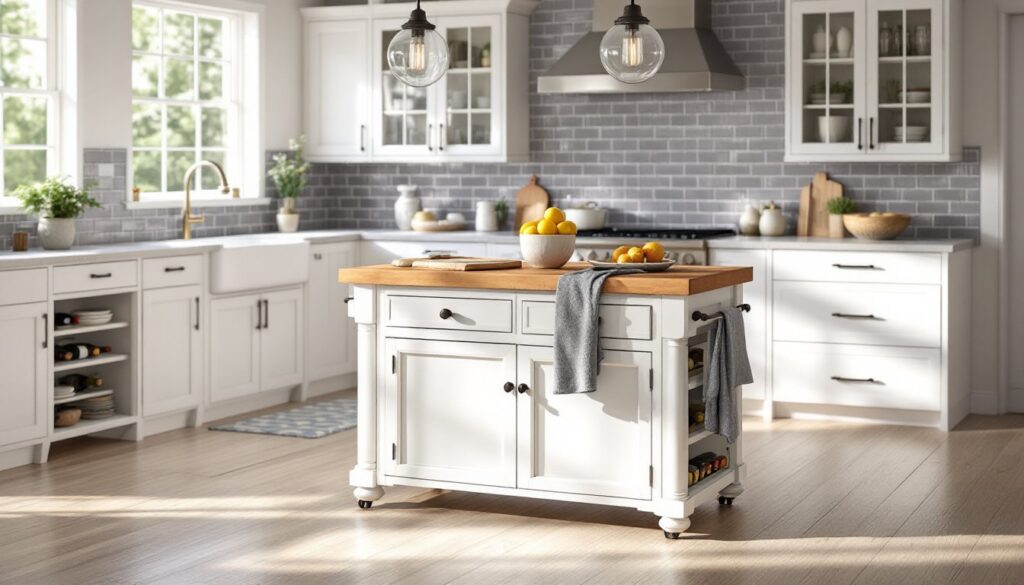
Crosley islands also include practical features like adjustable shelving, spice racks, towel bars, and stemware holders. Many models come with locking casters, which let you reposition the island for cleaning or reconfigure your workspace, then lock it down when you need stability for prep work. The wheels are typically 2-inch rubber casters rated for smooth floors, if you have textured tile, check the wheel diameter and consider upgrading to larger casters for easier rolling.
Popular Crosley Kitchen Island Styles and Collections
Crosley’s catalog leans heavily into traditional and transitional aesthetics. Their most recognizable lines include raised-panel doors, turned legs, and crown molding details that echo early American furniture. If you’re after a modern slab-door look, you won’t find it here, Crosley sticks to classic styling.
The Natural Wood Top Collection features islands with a clear-coat rubberwood surface over painted MDF or hardwood base cabinets. Finishes include white, black, cherry, and classic cherry, with antiqued hardware (oil-rubbed bronze or satin nickel). These units often include a mix of drawers and cabinet doors, with adjustable interior shelves.
The Butcher Block Top Series pairs a thicker cutting surface (usually 1.5 inches) with a painted base. The butcher block is end-grain or edge-grain depending on the model, end-grain is more forgiving on knife edges but costs more. You’ll see these in vintage white, gray, and navy finishes.
Stainless Steel Top Islands are designed for serious cooks who want a commercial vibe. The steel is typically 18-gauge, wrapped over an MDF core, with a subtle brushed finish. Many home improvement experts favor stainless for its durability in high-use kitchens. These models also tend to include open shelving or wine racks instead of closed cabinets.
Granite Top Models use a composite granite tile rather than solid slab, it’s heat-resistant and easy to clean, though the grout lines can collect crumbs if not sealed. The granite sits in a routed recess, so it’s flush with the edge trim. Bases on these models are usually solid hardwood with distressed finishes.
Key Features to Look for in a Crosley Island
Before you commit to a model, check the overall dimensions (height, width, depth) against your kitchen clearances. Most Crosley islands stand 36 inches tall, standard counter height, but some breakfast-bar models go up to 42 inches with an overhang for seating. Depth typically ranges from 18 to 24 inches, and widths from 42 to 60 inches.
Look for soft-close drawer glides if you want to avoid slamming. Not all Crosley models include them, and retrofitting soft-close hardware afterward can be finicky. The drawer boxes themselves are usually dovetailed hardwood, which is a good sign for durability.
Adjustable feet or levelers are critical if your floor isn’t perfectly flat. Many Crosley islands include threaded levelers inside the legs or caster mounts. If the unit only has fixed legs, you’ll need to shim it level before securing.
Check the countertop overhang if you plan to use bar stools. A functional overhang for seating is at least 10 to 12 inches, measured from the cabinet face to the edge of the countertop. Some Crosley models have a decorative overhang that’s only 2 to 3 inches, which won’t accommodate knees.
Storage Solutions and Organization Options
Crosley islands pack a surprising amount of storage into a compact footprint. Look for models with a mix of deep drawers (for pots and small appliances) and cabinet compartments (for dry goods or mixing bowls). Drawer depth on most units is around 12 to 14 inches, which is enough for sheet pans if you store them vertically.
Pull-out trash or recycling bins are available on select models, these are mounted on full-extension slides and fit standard 13-gallon bags. If your model doesn’t include one, you can retrofit a pull-out kit, but you’ll need to remove an adjustable shelf.
Open shelving and wine racks are common on the sides or ends. Open shelves work well for cookbooks or baskets, but they collect dust. Wine racks are usually sized for standard 750ml bottles, with slots cut into a fixed wooden grid. If you store larger bottles or champagne, measure the openings first.
Spice racks and towel bars are small touches, but they keep essentials within reach. The spice racks are typically narrow shelves (about 3 inches deep) mounted on the end panel or inside a cabinet door. Towel bars are usually 18 inches long and mounted on the side or front apron.
Sizing Your Crosley Kitchen Island for Your Space
Building codes and kitchen design standards call for a 42-inch clearance on all sides of an island to allow cabinet doors and appliances to open fully and to provide comfortable traffic flow. If you have a galley or single-wall kitchen, you might get away with 36 inches, but that’s tight if two people are cooking.
Measure your kitchen floor and mark out the island footprint with painter’s tape before you buy. Walk around the taped outline and simulate opening your refrigerator, dishwasher, and oven. If the island blocks any door swing, you’ll need a smaller model or a different placement.
Crosley islands on casters add about 2 inches to the overall height (including the wheel). If you have low-hanging pendant lights or a range hood, confirm the clearance. Standard range hood clearance is 24 to 30 inches above the cooktop, if your island will hold a cooktop or induction burner, you’ll need an overhead vent or downdraft system, and that’s a job for a licensed electrician and HVAC tech.
For seating, the general rule from design pros is 24 inches of countertop width per person. A 48-inch island can seat two: a 60-inch island can seat two comfortably or three in a pinch. Counter-height islands (36 inches) pair with 24-inch stools: bar-height islands (42 inches) need 30-inch stools.
Assembly and Installation Tips for DIY Success
Crosley islands ship flat-packed with an illustrated instruction manual and all necessary hardware. Plan for 2 to 4 hours of assembly time, depending on the complexity of the model. You’ll need a Phillips screwdriver, rubber mallet, adjustable wrench, and a drill/driver with a magnetic bit holder. A second pair of hands helps when aligning panels and flipping the assembled base upright.
Before you start, unpack all components and inspect for damage. Lay out the hardware and compare it to the parts list. Missing or damaged parts usually require a call to Crosley’s customer service, have your model number and purchase receipt ready.
Acclimate the wood if you live in a humid or very dry climate. Leave the flat-pack in the room where you’ll use it for 24 to 48 hours so the wood adjusts to your home’s humidity. This reduces the risk of panels warping or joints separating later.
Follow the assembly sequence exactly. Most Crosley islands start with the base cabinet frame, then add doors, drawers, and hardware, and finish with the countertop. The countertop is usually the heaviest single component (butcher block can weigh 40 to 60 pounds), so lift with your legs and get help.
Cam locks and dowels are the primary fasteners. Dowels go into pre-drilled holes and align the panels: cam locks cinch everything tight. Don’t overtighten cam locks, one firm turn past snug is enough. Overtightening can strip the threads in the MDF or split the hardwood.
If your model has casters, install them before you flip the unit upright. The caster plates usually mount with four screws per wheel into a recessed plate or threaded insert. Check that the locks engage fully, a wobbly lock is a safety hazard.
Leveling is the final step. Use a 24-inch level across the countertop in multiple directions. Adjust the threaded feet or add shims until the bubble is centered. An unlevel island will cause doors to swing open or closed on their own and drawers to bind.
Styling and Customizing Your Crosley Island
Out of the box, Crosley islands look traditional, but a few tweaks can tailor them to your kitchen’s vibe. Swapping hardware is the easiest upgrade. The factory pulls are usually generic bin pulls or knobs: replacing them with brushed brass, matte black, or ceramic knobs takes about 15 minutes and costs $20 to $60 depending on your choice. Most Crosley cabinets use standard 3-inch or 4-inch center-to-center spacing for pulls, so off-the-shelf replacements fit without drilling new holes.
Painting or staining the base is doable if you’re comfortable with a brush and roller. Sand lightly with 220-grit sandpaper, prime with a bonding primer (especially over existing paint or veneer), then apply two coats of cabinet-grade paint or gel stain. Butcher block tops should not be painted, refinish them with food-safe mineral oil or butcher block conditioner instead.
Adding a backsplash or side panel can dress up an open side. Beadboard panels, shiplap, or peel-and-stick tile (like the kind used in bathroom remodels) attach with construction adhesive or small finish nails. Keep the backsplash low-profile, you don’t want it catching on chairs or blocking access to drawers.
Lighting transforms an island from functional to focal. Battery-powered puck lights or LED strips mounted under an overhang or shelf add task lighting without electrical work. If you want hardwired pendant lights above the island, hire a licensed electrician, cutting into drywall and running Romex requires permits in most jurisdictions, and it’s not a DIY job unless you’re experienced with the National Electrical Code (NEC).
Organize the interior with drawer dividers, pull-out shelves, or lazy Susans. Most Crosley cabinets have removable shelves on adjustable pegs, so you can customize the height to fit your cookware. Drawer dividers can be DIY (cut from 1/4-inch plywood) or store-bought spring-loaded models.